Now booking: collection runs from South of Broad out to Kiawah — start an estimate
Serving the Lowcountry
Repair & Restoration

Rug Repair & Restoration in Charleston

A selvedge worn through on the line a piazza door swings across, shredded fringe, a corner the puppy decided was a chew toy, a forty-year-old patch that no longer matches, or a rug that spent a night on a wet floor. Most of it is fixable by hand.

Hand Work

Repairs That Disappear Into the Weave

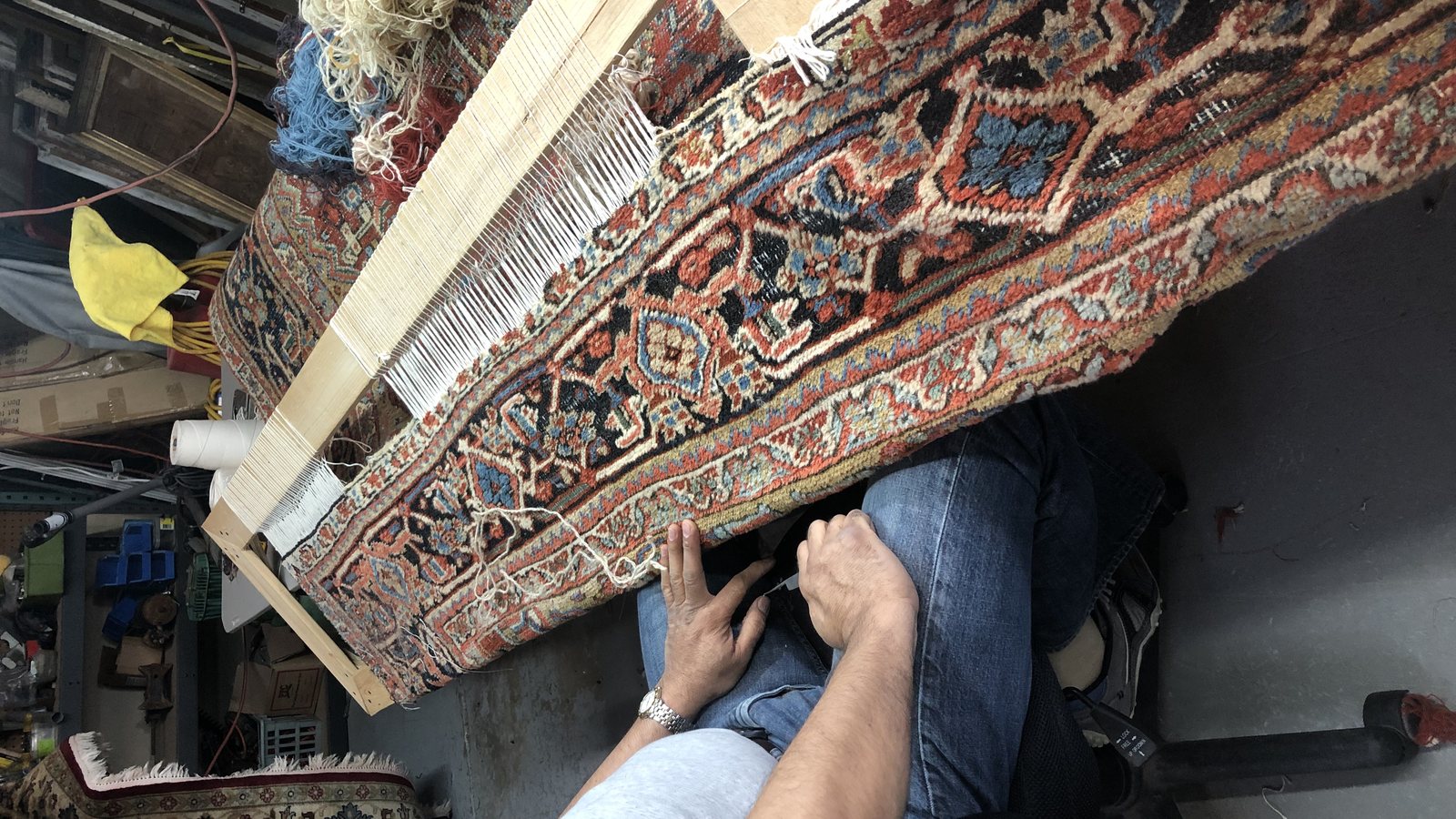
Repair is not a patch. A rug is rebuilt in the sequence it was made — foundation, then pile, at the knot count the weaver used and in wool matched to the dye lot — so that the restored ground shifts, wears and lightens along with everything around it. Done as it should be, nobody finds the repair without being told.

It is slow by nature. Reweaving is reckoned in square inches, at a loom, by hand, and nothing shortens it. What that buys is a far longer life than most owners have been led to expect. Rugs that have stayed in one family through several houses and several generations are routinely worth putting right.

Every job opens with a free assessment and a straight answer. Where the repair would cost more than the rug is worth, we say so and leave it there.

Matched wool being knotted back into an oriental rug at the repair bench
A reweave underway: wool selected against the dye lot, worked back into the ground of the rug.
What We Fix

Repair & Restoration Services

From an end that needs securing to a border rebuilt from nothing.

Fringe Repair & Replacement

Fringe is the foundation of the rug arriving at the end of the weave, not an ornament, so a shredded fringe is a rug coming undone. The commonest cause we see is not age, it is a vacuum beater bar taking a few warps a week for ten years. The ends get secured, lost warps rebuilt, and the fringe re-knotted or replaced against the original.

Edge Binding & Serging

Side cords take the abuse, and in a single house they take it in one place: a rug under a swinging piazza door wears on a line rather than over an area, so the selvedge fails long before the field looks tired. Once it splits, the pile beside it starts letting go. That edge is wrapped again by hand, in wool matched to the original cord.

Reweaving & Hole Repair

Worn-through ground, tears and burns are rebuilt knot by knot: the foundation first, then the pile above it, matched to the neighboring field in fiber, color and density.

Old Repairs Made Good

Charleston houses are full of rugs mended decades ago with whatever wool was to hand, in a room where nobody was going to look closely. Those patches age at their own rate, so they step forward the moment the field around them is cleaned. They can be taken out and rewoven properly — and it is worth knowing they are there before the rug is washed rather than after.

Pet Damage

Corners chewed, edges clawed open, dye burnt away by urine. The rug is decontaminated before a single knot goes in, then the missing structure is rebuilt and the color restored where the original dye has been destroyed.

Color & Dye Correction

Bleach spots, dye that travelled during a bad cleaning or a soaking, and the pale chalky band along the edge that lay against a masonry wall. Color is rebuilt by hand where the fiber underneath is still intact.

Resizing & Reshaping

Rugs cut down to fit a narrow downtown room, or blocked back to square after years of buckling. A cut edge is finished so the rug looks intentionally sized rather than trimmed to fit.

Backing & Foundation Repair

Failed latex on hand-tufted rugs, split warps in antiques, and rugs that ripple because the foundation gave way. Cellulose foundations are also the part of a rug that insects go for, so damage found on the back is assessed as a structural problem first. Nothing cosmetic is begun until the structure holds.

Rug Pads & Prevention

Plenty of the work on this bench would have been unnecessary given a decent pad and a vacuum with the brush switched off. We fit breathable, non-adhesive pads sized to the rug, which matters most in a doorway, where a rug that shifts under a swinging door wears twice as fast.

Local Conditions

What Charleston Air Does to a Rug’s Foundation

Charleston is damp 215 days a year, 59% of the calendar, which is near the top of this network — but the longest unbroken damp run in the five-year record is only 39 days. High total, broken delivery. A rug that is wetted and dried dozens of times a year fails differently from one that is simply held wet, and the repairs reflect it.

215
Days a year at or above 75% relative humidity
39
Longest unbroken damp run, in days
5
Nights a year at or below freezing
50.7
Inches of rain a year

High total, broken runs

215 days a year above the mold threshold with a longest unbroken run of 39 days means the air here keeps letting go and taking hold again, and the daily maximum reaches 95% on 31.4% of days.

Cotton swells as it takes up moisture and shrinks as it gives it back; wool moves less, and later. Cycling that joint dozens of times a year is what loosens side cords and works fringe knots open.

So rugs arrive here off-square and rippling more often than they arrive rotted, and the fix is blocking and edge work rather than reweaving.

Where the house puts the rug

In Mount Pleasant and I’On the rugs are mostly on slab, which behaves nothing like a joisted floor.

A slab is in direct contact with ground moisture and, in older construction, often has no vapor barrier under it; a rug laid straight onto one is being wetted from below continuously rather than seasonally, and the cotton foundation is the part in contact with it.

Harleston Village and Ansonborough bring solid masonry into it, and masonry holds cold long after the air in the room has warmed.

The coldest surface in a masonry-walled room is the floor along the exterior wall, which is exactly where a room-sized rug ends. It picks the moisture up in the foundation rather than the pile, where nobody is looking for it.

The oldest housing on the collection route goes back to the 1830s, and construction of that age was not built to keep ground moisture out of the rooms above it — which is worth remembering before blaming a rug's condition on the rug.

What that actually sends in for repair

Foundation loss, not surface wear

Cellulose held damp loses strength, and 39 unbroken days above 75% is long enough for it to matter.

A foundation going that way gives no cosmetic warning, so the test is mechanical: fold a corner and see whether it flexes or crackles, and pull gently on a fringe tassel to see whether it is still anchored in anything.

Fringe, because fringe is the foundation

Fringe is the warp ends of the rug, not a trim, so 215 days a year of damp working on cotton warps shows up there before it shows up anywhere else.

Once the ends let go the rug starts unravelling from the edge inward, which is why a fringe that has begun to shed is worth dealing with while it is still a fringe job.

Dyes that moved before we saw the rug

149 days a year reach 80% relative humidity, where a wet rug stays wet, and an unstable dye that is kept wet and warm will travel.

Most of what looks like a stain on an old rug is dye that migrated during an earlier soaking, and it is corrected by hand where the fiber is still sound rather than by washing harder.

Figures above are from the ERA5 reanalysis record for the five years from 2021 through 2025, taken at the center of the the Lowcountry service area. If what you are seeing on your rug matches any of this, send photographs and we will tell you which of these it is.

Wet Rug Service

Leaks, Flood & Water Damage Rug Restoration

A supply line behind a washing machine, a water heater at the end of its life, rain driven in along an open piazza, or a floor that was wet-mopped under the rug once a week for a whole letting season. The rug on that floor is now on a clock.

Why speed matters more than anything else

Wool survives a soaking far better than people assume. Staying wet is the part it does not survive. A saturated foundation in a warm room is colonized by mold in something like forty-eight hours, and once the growth is at the base of the knots nothing you vacuum, spray or blow at it will lift it out. Charleston hands a rug a warm room for most of the year and only a handful of frosts to interrupt it. At the same time, unstable dyes begin to travel, cotton foundations start to rot, and whatever the water carried is curing into the weave.

The slow version does the same damage without ever looking like an emergency. A rug put back onto a floor that was mopped an hour ago is taking water from underneath, and a rug that does that weekly never gets a genuinely dry stretch — the edges nearest the doorways go soft first, and nobody connects it to anything. Either way, a fan aimed at a wet rug is not restoration: it dries what you can see, seals the rest into the foundation, and produces a rug that behaves for three weeks and then does not.

What to do before we arrive

  • Lift it clear of the wet floor and move the furniture off it — a wooden leg on a damp pile bleeds stain into the wool in a matter of hours.
  • Do not seal it in plastic. Wet wool inside a sealed roll is an incubator; keep it loose and open.
  • Photograph it where it lies, still wet, before a thing is moved. That is what the claim will rest on.
  • Do not give it a half-rinse with a hose and walk away. That fixes the contamination in place and makes the proper wash harder.
  • If the house is a rental and you are elsewhere, send the housekeeper or the manager to lift it and photograph it. Days matter more than distance.

The restoration sequence

  • Priority collection. Wet rugs are taken out of order and run ahead of routine washing where the schedule allows.
  • Category assessment. Clean supply water, gray water and flood water are three different jobs, and which of them you have sets the method.
  • Extraction and full flush. Contamination and dissolved salts are flushed out through the foundation rather than trapped behind a dry surface.
  • Antimicrobial treatment. Carried through the whole rug, both faces, before any drying starts.
  • Monitored flat drying. Filtered air across a flat rug, metered to completion, so nothing is returned with moisture still in it.
  • Dye-bleed correction. Color that migrated while the rug was saturated is drawn back as far as the fiber will allow.
  • Structural repair. Rotted ground and lost pile are rewoven once the rug is dry and stable.
  • Claim documentation. Photographs throughout, and a written condition report to go to your carrier.
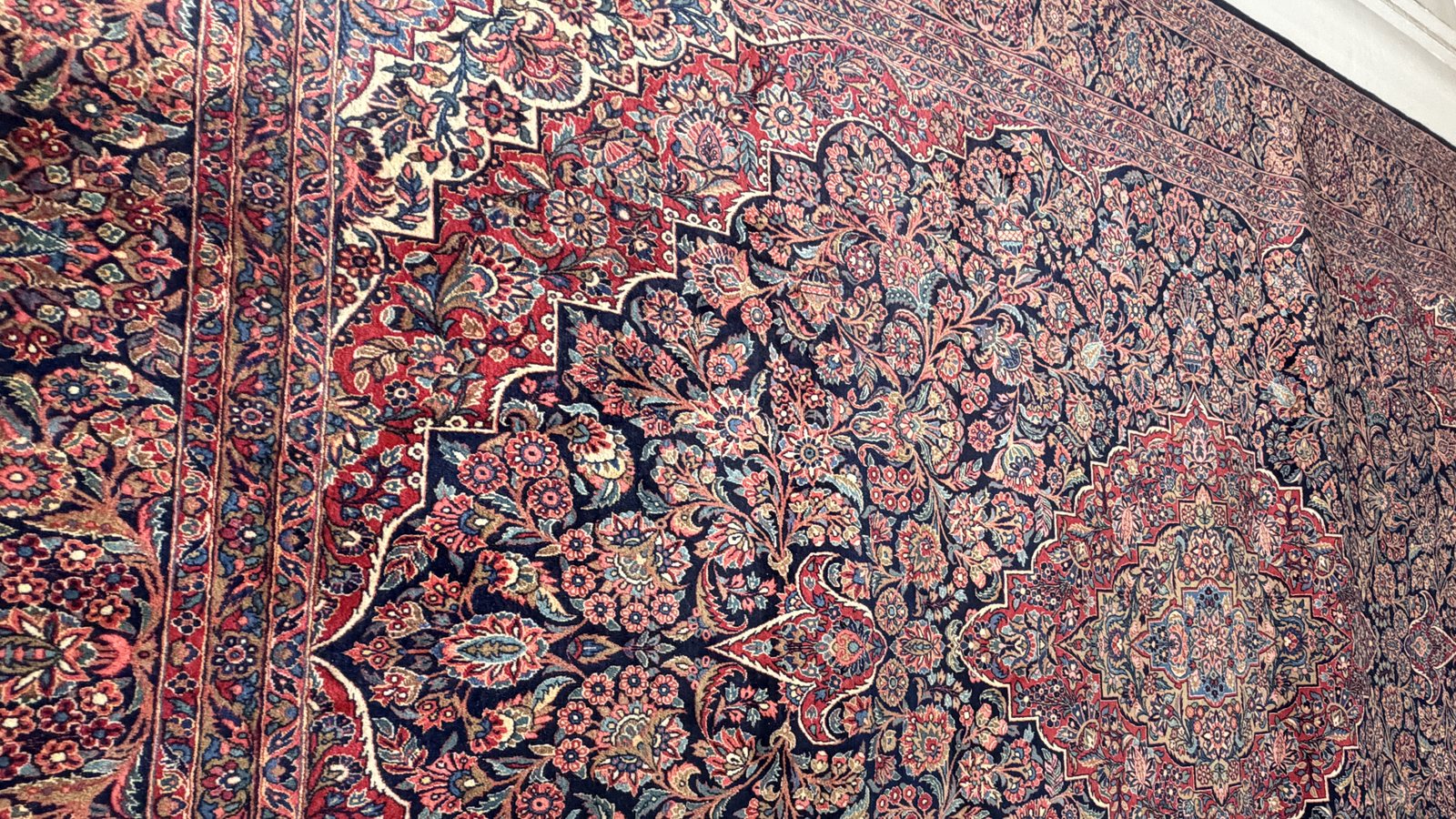
A rug photographed flat after water-damage recovery, field color brought back through the pile
How It Works

From First Message to Delivery

Photos or Collection

Send pictures of the damage, or we collect the rug at no charge anywhere on the Charleston and Berkeley route.

Assessment & Quote

The damage is mapped, materials identified, and a written price with options comes to you. Nothing is begun before you approve it.

Clean First

Repairs go into a washed rug. Knot new wool into a dirty field and in twelve months the repair is the first thing anybody sees.

Materials Matched

Wool is selected against the original for fiber, weight and dye lot, then tried against the field before it is committed.

Hand Repair

The foundation is rebuilt, then the pile is knotted in at matching density and sheared down to the surrounding height.

Final Check & Return

Groomed, checked against the intake photographs, and returned to the floor it came off.

Questions

Repair & Restoration FAQ

Is my rug worth repairing?
You are told plainly, before anything begins. A rug is worth repairing when it means something or is worth something, and when the ground it is woven on is still sound. Where the repair would cost what the rug is worth, that gets said out loud rather than buried in an invoice.
How long does rug repair take?
That depends on the area involved. Reweaving is hand work reckoned in square inches, so a coin-sized hole and a rebuilt border are not the same undertaking. The timeline is written into the quote before you agree to anything. Water damage is treated as urgent and does not wait its turn.
My rug is only worn along one edge. Why?
Almost always a door. A rug that sits where a door swings across it takes its wear on a line rather than over an area, which is the classic pattern in a single house where the piazza door is the door everybody uses. The selvedge goes first, then the end weft, and the rug starts letting go from the edge inward while the field is still perfect. It is a repair rather than a cleaning problem, and a pad that stops the rug shifting under the swing is most of the prevention.
Will the repair be visible?
A good reweave is difficult to find after the pile is groomed. The wool is matched for fiber, dye lot and knot density, and the foundation goes back before the pile, so the mended area ages at the same rate as the field rather than dropping away or riding above it.
The house is being treated for termites. What should I do with the rugs?
Get them out of the house rather than into a corner of it. When a building is treated or tented everything comes off the floor at short notice and gets rolled and stacked by people whose job is the building rather than its contents — which is how rugs end up rolled dirty, rolled damp, folded instead of rolled, or stood on end on a garage slab for a week. Ideally the rugs leave clean and come back afterwards. Worth knowing too: the foundation of a rug is cellulose, so it is not automatically outside what those insects will take, and the damage starts on the underside.
Do you work with insurance claims?
Yes. The condition is photographed on arrival and as the work proceeds, and you are given a written account of the damage, the treatment and the effect on value for the carrier.
My rug ripples and will not lie flat. Can that be fixed?
Usually, yes. A rug buckles because the foundation has gone uneven, because it was dried badly once, or because it has spent years on a pad with no support in it. It is washed, blocked back to square under tension, and the foundation is repaired where it has stretched or split.

Send Us a Photo. We Will Tell You Straight.

A free assessment on every piece, and a plain answer about whether the repair is worth making.

Rug Cleaning

Each of the six stages of the hand wash, and why in-place wand cleaning is the wrong answer in this city.

Cleaning process

Charleston Care Notes

Piazzas, plaster dust, masonry salts and rental turnover — what rug owners here need to know.

Care notes

Book a Collection

Collection and delivery included across Charleston and Berkeley counties.

Contact us
Start a Free Estimate Service Areas